The team could ship features on schedule and still fail the only metric that mattered to the business: how long finished work sat between merge and production. Releases were senior work, checklist work, and calendar work. Everyone knew the process had become the bottleneck. Nobody had a story for changing it that did not sound like a tooling fad or a compliance risk.
Where the pattern repeats
In 2021 I kept seeing the same shape in different teams: finished work parked away from production, a batch release rhythm, and changes big enough that production practice stayed rare. In that same year I started introducing a different developer posture to teams that were ready to run it. That work has continued across several years and several industries. Fintech and specialized AEC/BIM are two places where the counterintuitive part is clearest.
In regulated fintech, money and compliance are never abstract. Releases are audited, rollbacks are expensive, and the instinct is to add gates, not remove them. The teams were capable. The calendar was the constraint.
In specialized AEC and BIM software, many people assume Waterfall is mandatory. Standards are heavy, mistakes in the field are costly, and regulations read like permission slips for big batches. Yet the bottleneck was still delivery habit, not the domain's inherent complexity.
Legaltech and other platform teams showed the same physics. Fintech and AEC/BIM make the surprise hardest to dismiss.
How we ran the change
Nothing moved until people were willing to name what hurt and stay in the conversation: push back on the release train without turning it into a blame session, and listen to what I was proposing before anyone touched the pipeline. Identifying the problem mattered. Showing up for those chats mattered more.
- 01Trunk-based development
- 02Automated tests
- 03Feature flags
Once the room shared that frame, the shift that moves the needle became clear: weeks to hours, a different kind of delivery, not a faster release train. Trunk-based development on the pipeline you already have, automation that counts as evidence (shift left), and feature flags made merge-to-production lead time honest and kept small changes small.
Measure lead time from commit or merge to production, not "ready for the next train." Speed up only where tests and flags can carry what calendar gates used to stand in for.
Integrate on main. Do not park finished work on long-lived release branches. Encode the decisions reviewers already made (parity, smoke, checks that mean what the team believes) and drop gates whose only job was to wait for a slot. When merge-to-production is fast, risky slices ship narrow or behind a flag.
On a regulated fintech purchase-and-platform product, that plan landed with the team on the existing pipeline. Blocking QA gates came out. Testing automation and flags joined the safety model they already trusted. Release confidence rose rather than fell, and the team shipped less busywork because nothing rewarded batching into the next train.
Still true in an AI-native era
Models make more change cheaper to propose. They do not relax the quality bar. In regulated fintech and specialized AEC/BIM, the lived problems were release trains, hand-offs, and QA gates that queued work instead of practicing production.
What replaced that habit is an intelligent system, not code pushed through a simple linear pipeline that still waits on a calendar. It runs as a self-verifying loop: merge, run the evidence, ship or stop with a clear signal. Trunk-based flow, true evidence in the pipeline, and feature flags let the same enablers absorb faster suggestion without pushing risk back into a weekly train.
When AI can land a production-ready change in about fifteen minutes, shaving a couple of hours off an already-fast loop is incremental tuning, not the headline transformation.
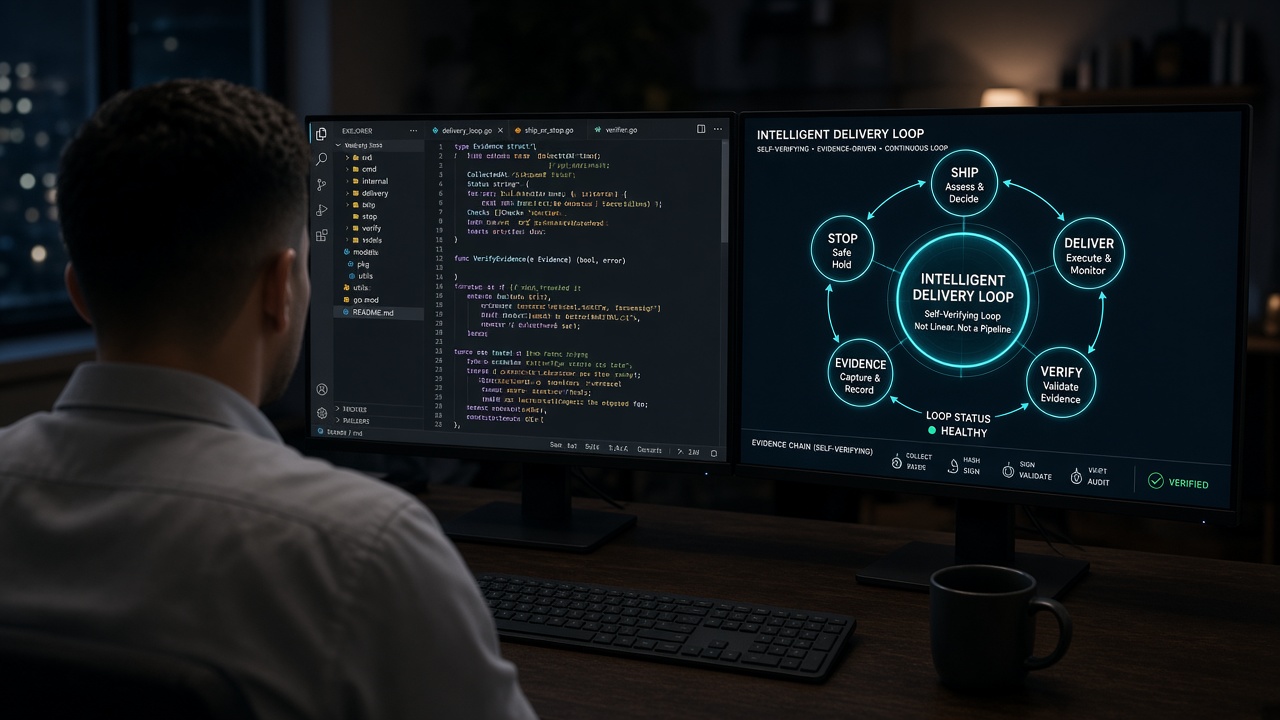
This note stays on the delivery spine: weeks to hours, across regulated fintech and specialized AEC/BIM, with an exact 5× lead-time step on ordinary changes. A later piece will cover reviewing faster without dropping the bar.